



Living as a Shadow: Rahu and Ketu, the Celestial Cats
This is a bilingual article presented in both English and Japanese.
チェンマイのJJマーケットの道路挟んで反対側にあるJing Jai Village Chiangmai。
洗車で時間潰しをしているとき、ある雑貨ショップで一枚のTシャツに足が止まった。
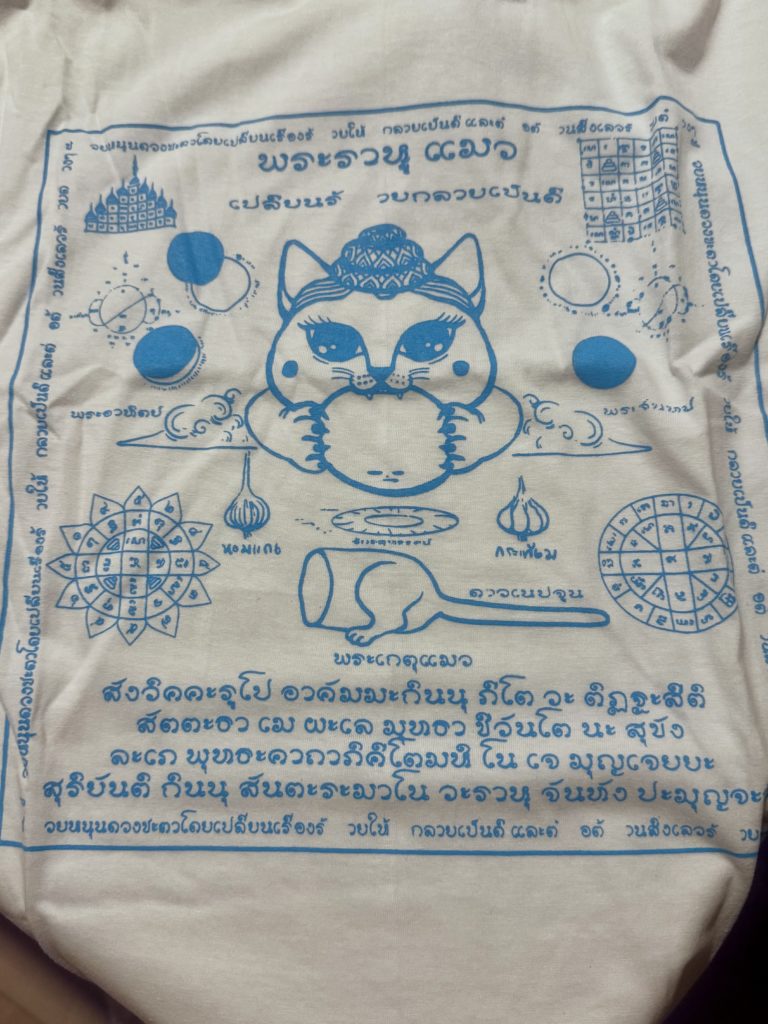
柔らかな白地に、涼しげな青の線。 どこか愛嬌のある猫の姿の上に、タイ文字ではっきりと「พระราหู(プラ・ラーフー)」と刻まれている。
ラーフーとは、インド神話に登場する影の神で、日食や月食を引き起こす存在とされている。
At Jing Jai Village Chiangmai, located just across the street from JJ Market. While I was killing time waiting for my car wash, my eyes were caught by a single T-shirt in a boutique. On a soft white background with serene blue lines, a cat was drawn. Above its somewhat charming figure, the Thai letters clearly read: “พระราหู” (Phra Rahu).
Rahu is the shadow deity from Indian mythology, believed to be the entity that causes solar and lunar eclipses.
ラーフーとは?日食・月食を引き起こす影の神
What is Rahu? The shadow deity who causes eclipses.
ラーフー神。
太陽と月を飲み込み、食を引き起こす「影」の阿修羅。
不死の霊薬アムリタを口にしたその瞬間、太陽と月の告発を受けたヴィシュヌ神は、スダルシャナ・チャクラと呼ばれる光の円盤を投げた。首は切り落とされたが、すでにアムリタが喉を通っていたため、ラーフーは頭部だけの存在として生き続けることになった。
The deity Rahu.
An Asura of “shadow” who swallows the sun and the moon to cause eclipses.
At the very moment he tasted the nectar of immortality, Amrita, Lord Vishnu—alerted by the Sun and the Moon—hurled his luminous disc known as the Sudarshana Chakra. Though his head was severed, the Amrita had already passed through his throat, allowing Rahu to continue living as a head alone.
猫の喉の下に描かれたひとつの円盤に目が留まる。
あれは、もしかして彼を両断したヴィシュヌのチャクラなのだろうか。
欲望を断ち切った秩序の輪が、彼の一部としてそこに描かれている。
このTシャツ、こんなに可愛いのになかなか奥が深い。
My eyes were caught by a single disc drawn under the cat’s throat.
Could that be the very chakra of Vishnu that severed him?
The wheel of order that cut through desire is depicted right there, as a part of him.
This T-shirt is surprisingly profound, despite being so cute.
ラーフーとケートゥの違い:頭と尾に分かれた存在
The Difference Between Rahu and Ketu: A Being Split into Head and Tail
さらに視線を落とすと、そこには本体から切り離された猫の下半身と尻尾が描かれていた。
占星術において、ラーフーの頭部と分かたれたその胴体はケートゥと呼ばれる。
Looking further down, I saw the cat’s lower half and tail, severed from the main body. In astrology, the body that was separated from Rahu’s head is known as “Ketu.”
ラーフーが未来への渇望や執着なら、ケートゥは過去の業(カルマ)や解脱を司る。
言い換えるなら、ラーフーが「まだ手に入れていないものへの渇望」で、ケートゥは「もう手放したものの残像」だ。
ケートゥは、手放した後の静けさを知っている。
一つの存在が二つに裂かれ、天の反対側に位置しながらも、見えない糸で結ばれた一対の影。
その奇妙なデザインは、私たちの内側にある思考と本能、あるいは光と闇の逃れられない結びつきを写し出しているようだ。
While Rahu represents cravings and attachments toward the future, Ketu governs past karma and liberation. In other words, if Rahu is the “thirst for what we have yet to obtain,” Ketu is the “afterimage of what we have already let go.”
Ketu knows the stillness that comes after letting go.
Though split into two and positioned on opposite sides of the heavens, they remain a pair of shadows bound by an invisible thread. This curious design seems to reflect the inescapable connection between our “intellect” and “instinct,” or our “light” and “shadow.”
タイで祀られるラーフー信仰とは
The Worship of Rahu in Thailand
タイに移住してくる前の私は、ラーフーを不吉な神だと思っていた。
光を奪い、世界を混乱させる存在だと。
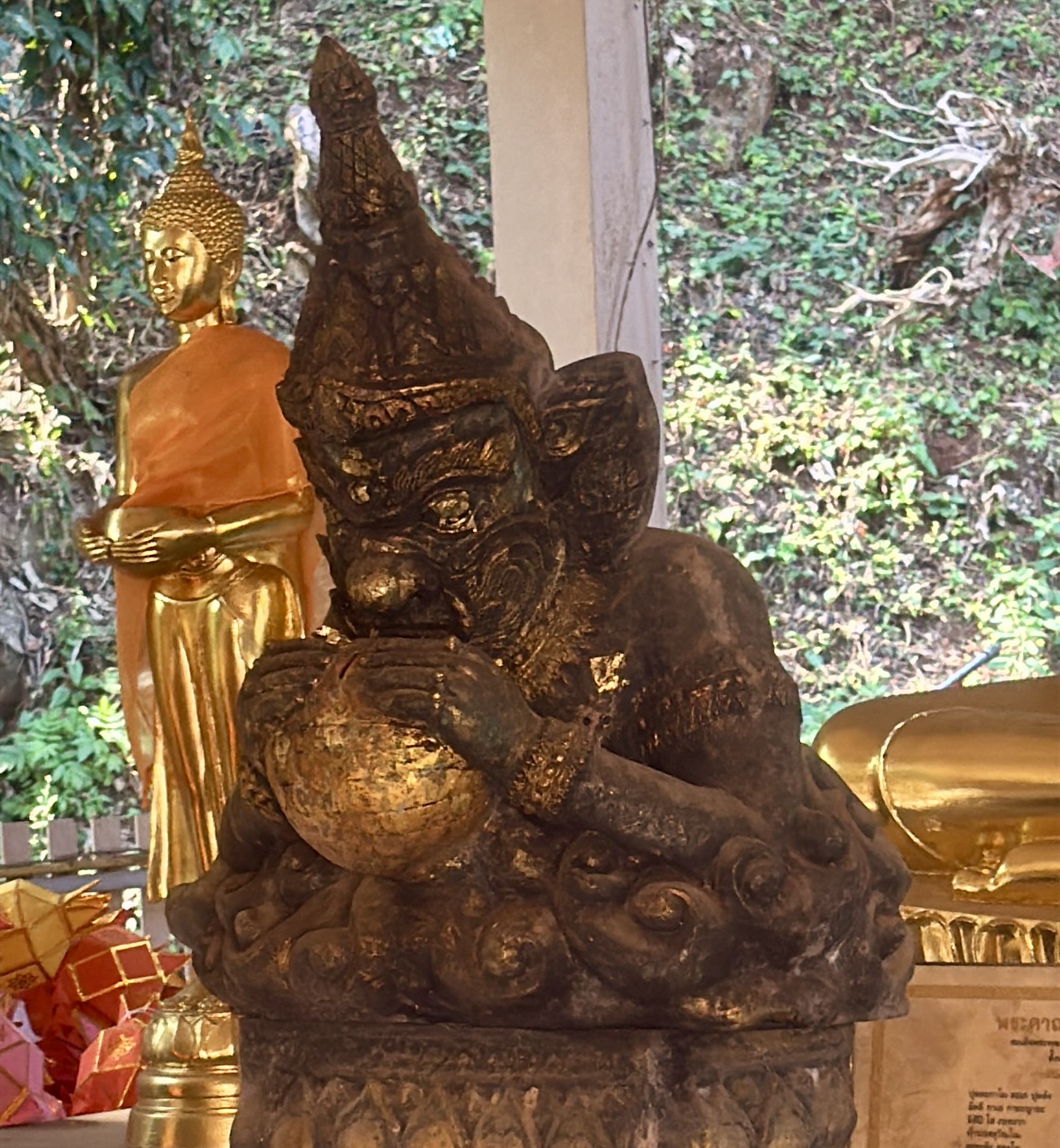
しかしタイの寺院へ行けば、人々は黒く艶やかな像の前で静かに手を合わせている。
そして黒い供物を捧げ、転機や厄年の無事、そして逆境を力に変える強い運を願う。
影は、遠ざけるものではなく、その力を借りるもの。
Before moving to Thailand, I used to think of Rahu as an ill-omened deity—an entity that steals the light and throws the world into chaos.
However, when you visit temples in Thailand, you see people quietly pressing their hands together before his sleek, black statues. They offer black gifts and pray for safety during life’s turning points or unlucky years, seeking the “strong fortune to turn adversity into power.”
The shadow is not something to be kept at a distance; it is something to draw power from.
日食・月食の意味|影は不吉なのか
The Meaning of Eclipses: Is Shadow Really an Ill Omen?
日食や月食の時、アーユルヴェーダの世界では外出を控え、食事を避け、静かにマントラを唱えるという。
エネルギーが乱れるからだという人もいるけれど、私はそれを「乱れ」ではなく「反転」と呼びたい。
外側の光が翳るとき、意識は否応なしに内側へと向かう。
太陽が隠れ、月が闇に包まれるその一瞬、世界の空気感が変わる感じがする。
ラーフーは光を消す神ではない。
光を一度隠すことで、その尊さを思い出させる装置なのだ。
占星術では、魂はラーフーの「入口」から欲望とともにこの世へ入り、ケートゥの「出口」から業を溶かして還っていくとも言われている。
食(しょく)はその往還の縮図なのかもしれない。
闇の深さを知った目には、世界はより鮮やかに映るはずだ。
Tシャツの猫ラーフーの周囲を埋め尽くす、複雑なヤント(護符)とマントラ。
白地のキャンバスに描かれたその青い祈りは、単なる文様ではなく、影を味方につけるための知恵の結晶だ。
影は、光の敵ではない。
光を際立たせるための、美しい輪郭。
早速この「ラーフー猫」を着ようと思ったら、なんとサイズが小さすぎた笑
Lサイズなのにパツンパツンである笑
肌に直接、宇宙の周期を纏おうと思っていたのに!
これは妹へのお土産にして、またXLサイズがないか聞きに行こうっと。
このラーフーを身につけることは、自分の中の闇さえも愛し、新しい光を編み直していくための、小さなおまじないのような気がしているんだよね。
During solar and lunar eclipses, in the world of Ayurveda, it is said that one should refrain from going out, avoid eating, and quietly chant mantras.
While some say it’s because the energy becomes “disturbed,” I’d rather call it an “inversion” than a “disturbance.”
When the outer light fades, consciousness is inevitably drawn inward. At that moment when the sun is hidden and the moon is shrouded in darkness, the very atmosphere of the world feels as if it shifts.
Rahu is not a deity who erases the light. He is a device that hides the light for a moment, reminding us of its true preciousness.
In astrology, it is also said that the soul enters this world with desire through the “entrance” of Rahu and returns by dissolving karma through the “exit” of Ketu. An eclipse might be a microcosm of that sacred coming and going.
To eyes that have known the depth of darkness, the world must appear more vivid than ever.
The intricate Yants (talismans) and mantras filling the space around the Rahu cat on this T-shirt are not mere patterns. This blue prayer drawn on a white canvas is a crystallization of wisdom for befriending the shadows.
Shadow is not an enemy of the light.
It is the beautiful outline that makes the light stand out.
I was ready to head out wearing this “Rahu Cat” right away, but it turns out the size was way too small (lol).
Even though it’s a Large, it’s skin-tight!
I was planning to wear the cosmic cycle directly on my physical body!
I’ll give this one to my sister as a souvenir and go back to see if they have an XL.
I feel like wearing this Rahu is like a small charm—a way to love even the darkness within myself and re-weave a new kind of light.
Anoushka Shankar & Norah Jones : Traces Of You
On Music: Anoushka Shankar and Norah Jones
音楽について:
ラヴィ・シャンカルを父に持つ姉妹、アヌーシュカ・シャンカールとノラ・ジョーンズ。
Anoushka Shankar and Norah Jones—two sisters born to the legendary Ravi Shankar.
東洋と西洋。
瞑想と日常。
シタールの余韻と、柔らかな声。
East and West.
Meditation and Everyday Life.
The lingering resonance of the Sitar and the soft, velvet voice.
ひとつの源から生まれながら、異なる場所で花開いたふたりの音楽は、どこかラーフーとケートゥを思わせる。
分かたれながらも、見えない糸で結ばれた存在。
光と影が交差するそのあわいで、静かに内側へと意識を反転させる音。
Though born from the same source, their music blossomed in different worlds, somehow reminding me of Rahu and Ketu.
Beings who are separated, yet bound by an invisible thread.
日食や月食のように、一瞬、世界の空気を変えるための音楽。
Music intended to shift the world’s atmosphere for a fleeting moment—just like a solar or lunar eclipse.
